
.svg)



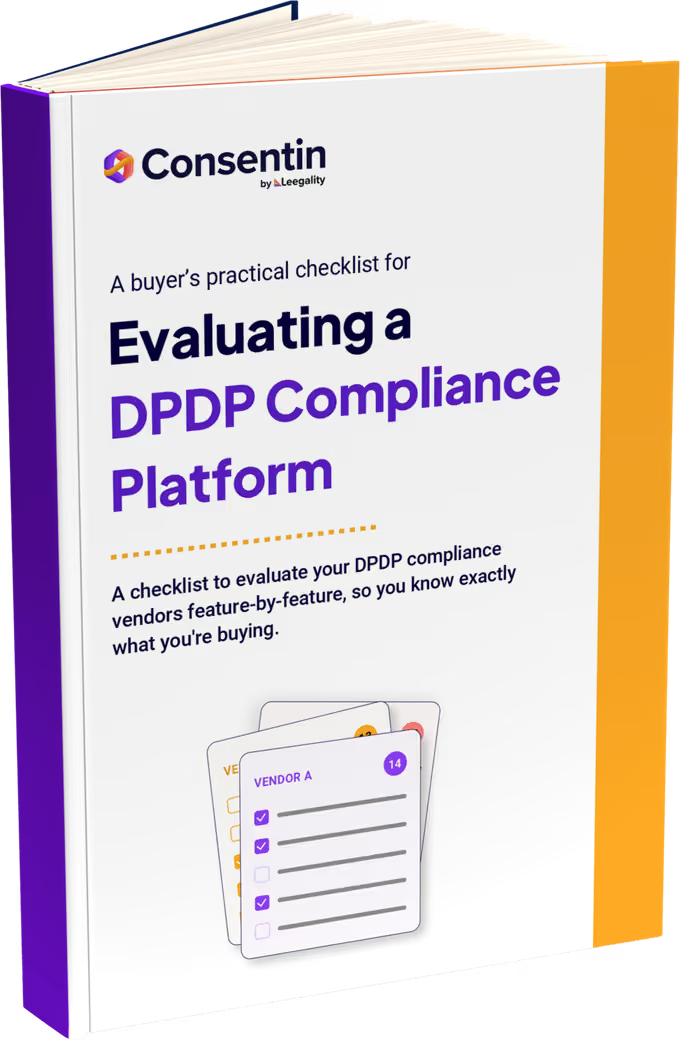
Evaluating DPDP compliance platforms? Download our checklist to evaluate every vendor on a common baseline
Most DPDP compliance platforms look identical in sales conversations. Everyone says they have every feature. Everyone exaggerates.
The reality will show up later after you go live, by which time it will be too late for you.
Compliance-first enterprises choose Consentin












4 questions to ask every DPDP vendor during evaluation
DPDP vendor demos usually go very smoothly. But will any of them actually work at scale?. Ask these questions to make sure your process doesn't break after go‑live.
Can I respond to consent withdrawal requests automatically, or does my team have to manually address each request?
Many DPDP compliance platforms simply provide you a front end for consent withdrawal requests.
After the withdrawal is received, your team has to wade through and process tickets manually.
If you process lakhs of data principals, this is unworkable, and your process will break when you go live.
How do you handle the conflict between a customer's withdrawal request and regulatory or legal retention periods?
The DPDP Act requires you to respond to consent withdrawal requests promptly. But regulators like the RBI, and some laws, require you to keep that data for other purposes.
Many platforms rely on database discovery based deletion and retention. This risks permanently deleting data that you still need to keep for the regulator.
Can you go live before May 2027, without first finishing a long drawn-out data-discovery project?
Most DPDP compliance vendors tell you to start data discovery first.
Unfortunately, data discovery projects for large entities take more than 9 months to complete. You won't be able to finish this AND implement DPDP workflows by the May 2027 deadline.
Inside the checklist
The full checklist has a scoring column. For each item it contains the outcome, the features, and space for your comments, so you can score every vendor against the same list.
What are DPDP compliance service providers?
DPDP compliance service providers provide the system infrastructure and support organisations need to meet obligations under the Digital Personal Data Protection (DPDP) Act and DPDP Rules.
What should you expect from a DPDP compliance platform
Most DPDP compliance platforms look identical in a sales deck. But the differences show up in implementations, audits, and when a rights request needs to be sent to multiple systems.
So, how do you pick the right platform? Here's what to look for while choosing a DPDP compliance platform:
DPDP compliance vendors: common questions
Usually both, for different jobs.
A consultant or auditor tells you where you stand today: which consent flows, notices and data practices are non-compliant. A platform is the software your compliance runs on every day after that: it collects consent, handles requests, retains and deletes data, and responds to breaches.
The audit finds the gaps. The platform closes them and keeps them closed.
No. A Consent Manager is an intermediary registered with the Data Protection Board under Rule 4 of the DPDP Rules, 2025. It helps individuals manage their consents across many companies. It handles only consent, not retention, deletion, breach notification or your other obligations. DPDP compliance software is what your organisation uses as a Data Fiduciary to meet those obligations, and it needs no registration.
Create a checklist of features you need and use the same checklist for every vendor. Ask them to show you each feature in a demo, not just tell you about it. Press hardest where platforms differ most:
Then check their credentials: certifications, live enterprise deployments and regulatory expertise.
Yes. As per Section 8(7) of the DPDP Act you have to erase personal data when consent is withdrawn or the purpose is no longer served, unless you need to keep it to comply with a law. Where a regulator or law requires you to retain data, you can retain it for as long as the law requires and only for that purpose. Consentin applies these rules for each purpose and each system, so data is never deleted earlier than a rule allows.
No. Consentin sends each instruction through the system's own API, and the confirmation is written back automatically. For systems your own team prefers to handle, such as a core banking system, the instruction goes to that team, and they close it with proof attached. Either way, every action is recorded against the ROPA record.
Implementation and ongoing support. The vendor should deploy the platform and connect it to your CRM, core banking and LOS systems. Ask for:
The pricing is usually calculated per consent, per data principal or per volume of data, or as a flat annual fee. Per-unit pricing may look cheap at pilot volumes but prices increase with every customer you add, so evaluate costs at your full volume before comparing vendors. Consentin offers a free plan of 3,000 consents a month for low volumes or live pilots.
Built for Indian compliance realities
Built by Leegality, which serves 100+ banks/NBFCs and 600+ enterprises.
Deep RegTech and compliance expertise
Built by lawyers.
India-first architecture
Phygital consent via agent-OTP and IVR.
India's only Retention & Deletion Orchestrator
Automates retention and deletion across your systems
Enterprise-grade security and governance
SOC 2 compliant. ISO 27001:2022, ISO 27017, ISO 27018, ISO 22301 certified.
Get the full evaluation checklist
Score every DPDP vendor against the same 16 categories — with outcomes, features, and space for your comments.
