



Hi there,
The third edition of the Lender’s DPDP Digest is here!
Most lending journeys today take consent from borrowers via a single checkbox or, at best, an OTP authentication. This type of consent is an “omnibus” consent - giving the lender full freedom to use the borrower’s personal data.
Under the DPDP Act, this single, omnibus consent no longer works!
You now have to ask for consent separately for each purpose, and show the customer a notice before you ask - right at the point of data collection.
As part of our DPDP implementation work with 50+ lenders, we’ve come across some common mistakes.
In this edition, we’ll cover the top 5 mistakes lenders make while building consent notices.
1. You cannot use the link to a privacy policy in place of a consent notice
In today’s journeys, borrowers can only find details of how their data will be used inside a massive (like really massive) privacy policy written in deep legalese.
This is a violation of the DPDP Act.
Under the DPDP Act, consent notices must be granular and contain:
- Each purpose listed as a separate line item
- The exact data being processed for each purpose
- The ability for a customer to opt out of any of the purposes if they so wish
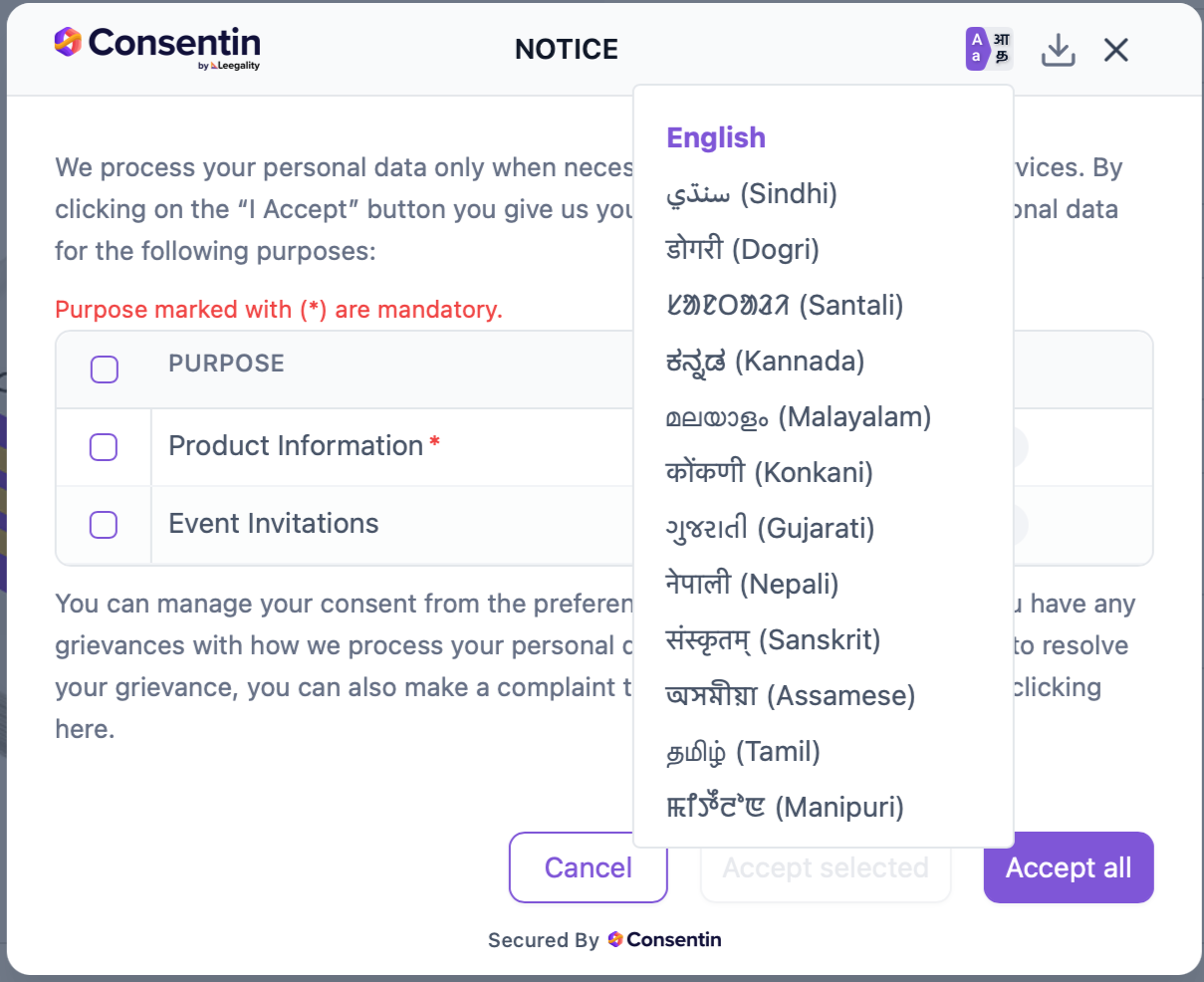
- Option to translate into 22 languages mentioned in the Eighth Schedule of the Constitution of India
- Details of how the customer can withdraw consent, raise a grievance and complain to the DPB in case of any violation
We’ve written in more detail about the exact requirements of a consent notice here.
You can (and should) still have a privacy policy, but you will also need a separate DPDP Act compliant consent notice in order to collect and use data with consent.
2. Don’t make your consent notices excessively complicated
An objection we hear from a lot of product teams is that DPDP consent notices will lead to drop-offs. It is a fair concern - when you split everything into separate purposes and data categories as the DPDP Act requires, there is more friction in the journey.
There are two measures you can take to prevent drop offs in your consent notice:
- Group data into categories your customer recognises. Instead of name, phone number and email ID, use terms customers understand like “contact details”.
- Let the customer move ahead with only the mandatory purposes in one click, and tick the optional ones if they want, so that the journey can be completed in two clicks.
Here’s a picture of two consent notice designs. Both are compliant. But only Version 1 makes it easy for the borrower to give consent - by adopting the two measures mentioned above.
For a full breakdown of how to build a drop-off free consent notice with images, see our blog: https://www.consent.in/blog/consent-journey
3. The customer cannot be forced to say yes to marketing or cross-selling to get the loan
Today, a customer can only proceed with the loan if they agree to provide marketing consent. They cannot refuse the cross-sell and still get the loan.
If they do not want their data to be used for marketing or cross-selling, they have to go and withdraw it separately later.
Under the DPDP Act and the RBC Amendments (which we covered in the First Edition) consent for the service must be kept separate from optional purposes.
The customer should be able to decline marketing and still complete the application.
4. Withdrawing consent cannot run through customer support
Today, if a customer wants their personal data updated or deleted – there is no real way to do it.
Under the DPDP Act, Data Fiduciaries (including lenders) are obligated to entertain and action consent withdrawal/data deletion requests by customers – creating a new class of transactions that businesses must service. It also says withdrawing consent must be as easy as giving it. If consent took one click, a helpline or email is not as easy.
Many Data Fiduciaries are adopting a “ticket based system” to collect and enforce such requests - via either a helpline or a customer support email.
Do not do this. Truly actioning a customer withdrawal/deletion request requires the ability to orchestrate multiple actions across all your systems – as fast as possible.
A support ticket based system or a manual helpline will not be able to perform this. It will have a huge backlog – and potentially cause irreversible data loss.
5. Your consent notice has to be available in 22 languages
Once the Act is in force, customers should be able to access the notice in any of the 22 languages scheduled in the Constitution.
It’s literally written in the DPDP Act -

Beyond the legal requirement, compliance with vernacular requirements is essential to ensure accessibility of DPDP consent workflows for Indian customers.
So keep the option visible on the notice, or use regional filters to open it in the right language by default - so that a customer does not drop off because they were shown the notice in English.
See you next Thursday!
